Skin health guide · RDG Clinic
Wart diagnosis and treatment in Riga
Many warts clear spontaneously, but a changing, painful, or uncertain growth should first be diagnosed. Treatment depends on type, site, number, age, and health.
Warts
Common skin warts are viral growths
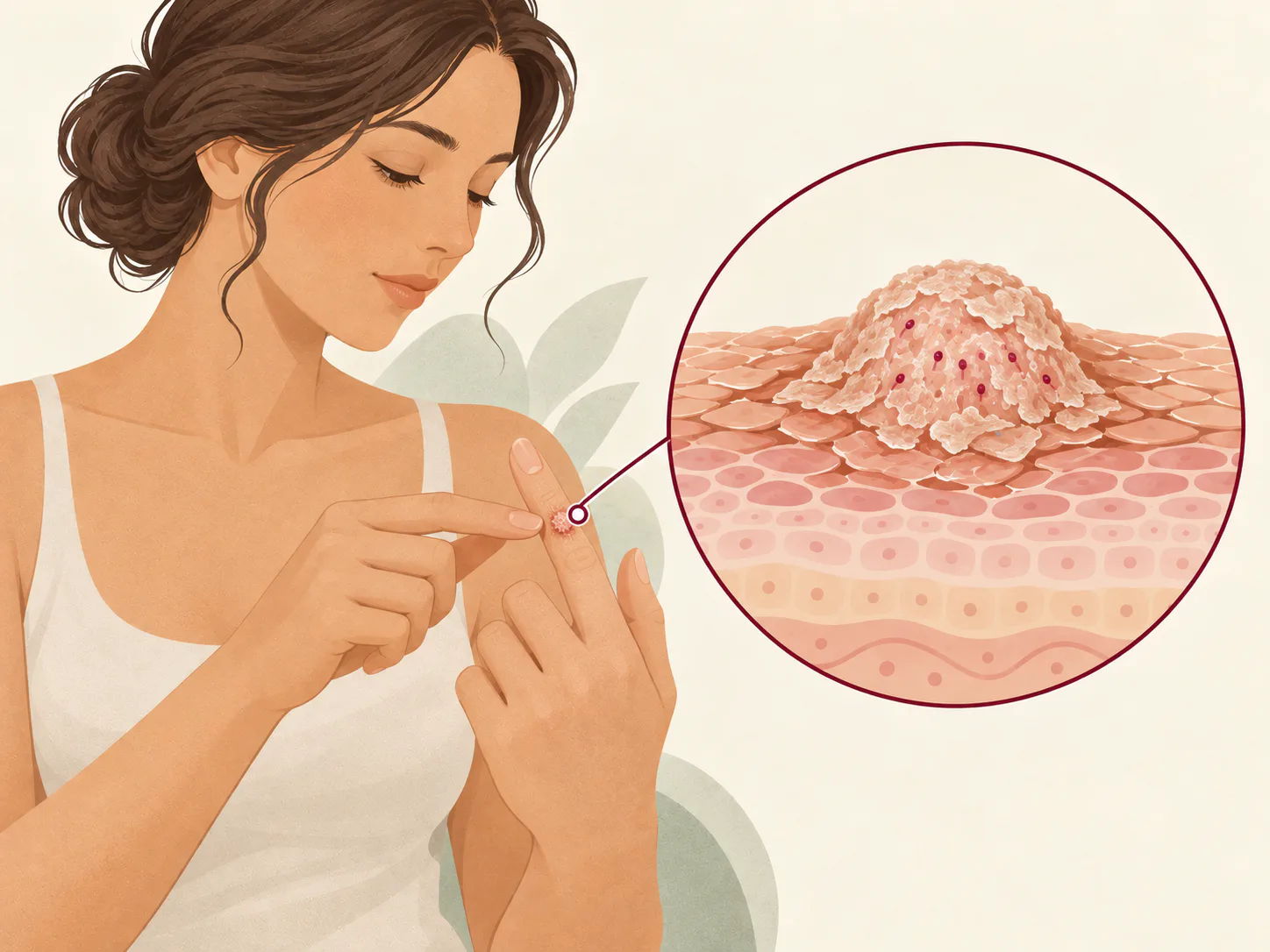
Common, flat, and plantar warts are caused by human papillomavirus types that infect the upper skin layers. They may be rough, flat, or appear as a thickened area on the sole because of pressure. Tiny dark dots are not “roots” but thrombosed capillaries. Warts can spread on the same person or to others, especially through damp or damaged skin.
This page concerns non-genital cutaneous warts. Genital growths need separate, confidential medical assessment. Not every rough growth is a wart: corns, seborrhoeic keratoses, and occasionally malignant lesions may look similar.
Common signs
- A rough firm growth on a finger or hand
- A small flat growth on the face or hands
- A painful thickened area on the sole that interrupts skin lines
- Tiny dark dots within the surface
When to see a dermatologist
When to see a dermatologist
- You are unsure whether the growth is a wart
- It changes, bleeds, ulcerates, is very painful, or grows rapidly
- It is on the face or beside a nail, or there are many lesions
- You have diabetes, poor circulation, immunosuppression, or home treatment has failed
Accurate diagnosis
How assessment works
A dermatologist usually diagnoses a wart by examination, using dermoscopy and gently paring surface callus when appropriate to reveal characteristic structures. An atypical, rapidly growing, ulcerated, or treatment-resistant lesion may need biopsy. Diagnostic confidence should precede a destructive procedure.
An individual plan
Treatment approach
Treatment is not always necessary. When a wart hurts, spreads, impairs function, or causes significant concern, the method is chosen jointly, including the risk of scarring and pigment change.
Observation
Many warts, especially in children, clear spontaneously over months or years; a painless confidently diagnosed lesion may be observed.
Home salicylic acid
A correctly selected and consistently applied product gradually removes thickened skin; surrounding skin needs protection and results take time.
Cryotherapy
In-clinic freezing may cause pain, blistering, and temporary colour change; repeated sessions several weeks apart are often needed.
Options for persistent warts
Selected cases may use curettage, electrosurgery, laser, or prescription therapy after weighing benefit against pain, scarring, and recurrence.
Your RDG care path
How the clinic can help
Services are selected after dermatologist assessment and according to the individual findings, not from a name or photograph alone.
Doctor consultation
In person or online: a professional assessment of your health and skin with a clear plan for next steps.
About this service →Skin biopsy and histology
A small tissue sample to clarify diagnosis, using the most suitable biopsy method with or without a stitch.
About this service →Skin lesion removal
Diagnosis first, followed by the most appropriate removal method and histology when required.
About this service →Long-term control
What to expect
No method guarantees clearance in one session. A wart may recur because treatment removes visible tissue while the immune system must control the virus. Do not cut or pick a wart at home; this increases spread, infection, and scarring risk.
This information does not replace medical consultation. Seek urgent medical care for sudden, severe, or rapidly progressive symptoms.
Dermatologists


Frequently asked questions
Does a wart have a root?
No. Dark dots sometimes called roots are usually tiny blood vessels, not a structure growing deep into the body.
Are warts contagious?
Yes, although they do not spread very easily. Risk rises with damp or damaged skin and when lesions are picked or shaved.
Can I treat a wart myself?
A typical hand or foot wart can often be treated with a pharmacy product, but not on the face or genitals, with diagnostic uncertainty, diabetes, or poor circulation.
Medical sources
Content updated: 13 October 2026
Treatment starts with an accurate diagnosis
After assessment, the dermatologist will explain the appropriate plan and costs. There is no single fixed treatment price because it depends on the diagnosis and therapy required.